The Giant Isopod: Deep-Sea Living Fossil and Resilient Marvel


Marine Biology
The Giant Isopod: Deep-Sea Living Fossil and Resilient Marvel

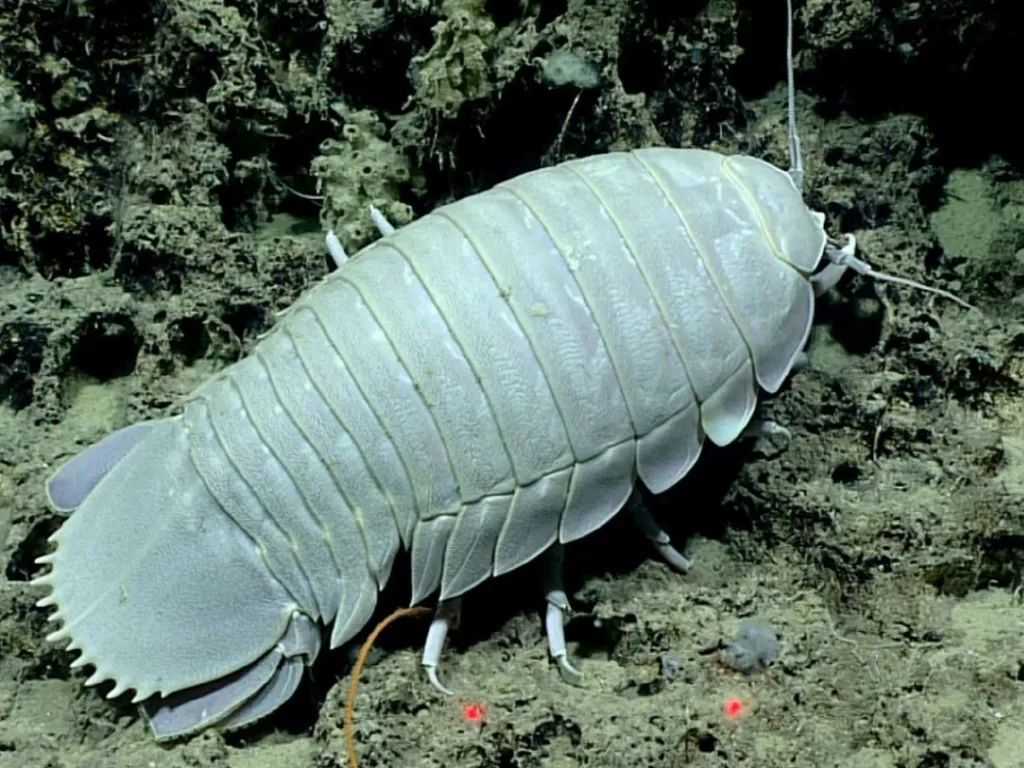
In the abyssal depths of the Indo - West Pacific and western Atlantic Oceans, the giant isopod, also known as the "giant deep - sea louse" or "deep - sea pangolin," roams. With an appearance resembling an oversized louse, it features two pairs of antennae, seven pairs of jointed limbs, and a distinctive shield - like exoskeleton made of calcium - rich scales that merge seamlessly with its head and tail.


This remarkable creature holds the title of the largest member of the water louse family. Its anatomy is a testament to deep - sea adaptation, including a pair of complex compound eyes composed of nearly 4,000 individual ommatidia, positioned on either side of its head. Having first emerged 160 million years ago, the giant isopod has survived through eons with minimal physical changes, earning it the moniker "living fossil of the deep sea."

The giant isopod's resilience extends beyond its evolutionary longevity. In 2014, a specimen at a Japanese aquarium shocked the world by surviving an astonishing 5 years and 43 days without food before succumbing—a record - breaking display of endurance. This extreme fasting ability, coupled with its ancient lineage and unique morphology, continues to captivate scientists, offering valuable clues about survival strategies in the most inhospitable oceanic environments.
 
 
Latest Stories
Travel News2 minute readIntroduction The Nord-Pas de Calais Mining Basin in northern France, once the beating heart of Europe's Industrial Revolution, now captivates the world with its unique story of industrial heritage revival. Spanning 120,000 hectares, this former coal mining hub was inscribed on the UNESCO World Heritage List in 2012 for its 109 preserved industrial sites and ecological restoration marvels.
Entertainment News1 minute readKatrina Kaif, a British-born actress who has made her mark in the industry, is celebrated for a beauty that defies easy description—one that leaves onlookers captivated.
Social News1 minute readThe longest country name ever recorded was that of a now-defunct state: the "Great Socialist People's Libyan Arab Jamahiriya." This lengthy title, used from 1977 to 2011, reflected the political ideology and structure under Muammar Gaddafi’s rule.
Social News1 minute readTajikistan, a 140,000-square-kilometer nation in Central Asia, grapples with stark poverty and systemic corruption. A surreal 2016 scandal saw billions in state funds vanish after being allocated to construction projects—exposing the grim reality of one of Asia’s poorest countries, with a GDP per capita of just $1,271.
Social News1 minute readPakistan, a South Asian nation with vast lands and nearly 240 million people, faces severe economic hardships, leaving millions of families in dire straits. The World Bank reports nearly a quarter of its population lives below the poverty line, with many households earning less than $100 monthly. Its GDP per capita stands at $1,461, while rising living costs make daily expenses unmanageable.
Car Information1 minute readOne of automotive history’s most iconic nameplates, the classic Mini, serves as the perfect canvas for retro modification projects. A recent collaboration between Callum (led by design legend Ian Callum) and Wood & Pickett brings together modern design sensibilities and upgraded chassis engineering, breathing new life into the British icon.
Travel News2 minute readNestled in the heart of the French countryside, the Château de Chantilly stands as a testament to centuries of artistic brilliance and aristocratic grandeur. This architectural marvel, often hailed as a "castle museum," seamlessly blends Renaissance opulence with a world-class collection of art and historical treasures, making it a must-visit destination for culture enthusiasts and history buffs alike.