The Leafy Sea Dragon: Master of Marine Camouflage from Australia’s Coastal Waters


Marine Biology
The Leafy Sea Dragon: Master of Marine Camouflage from Australia’s Coastal Waters

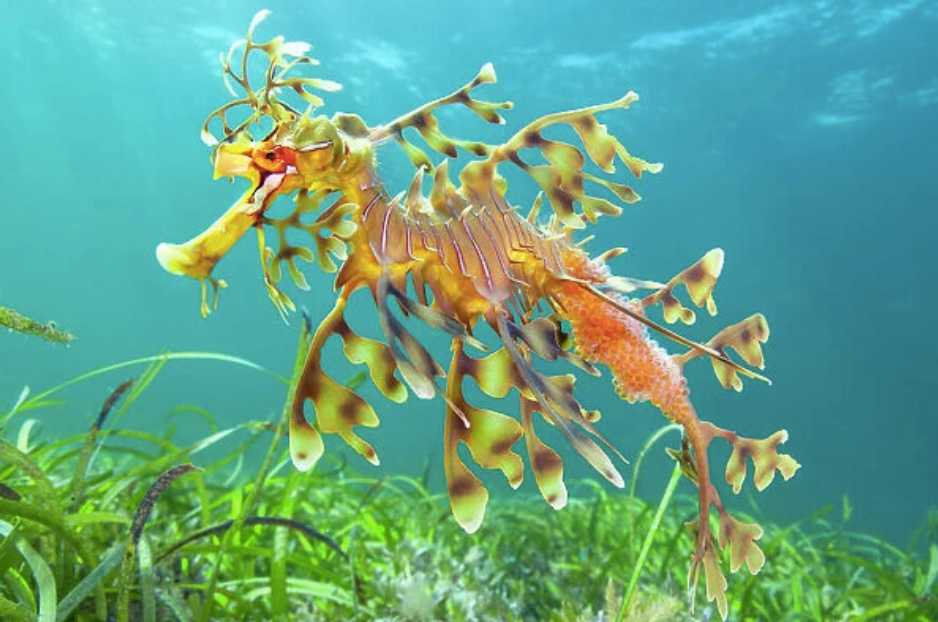
Belonging to the genus Phycodurus within the seadragon family (Syngnathidae), the leafy sea dragon is a remarkable fish adapted to life along the southern and western coasts of Australia. Recognized for its elaborate leaf-like appendages, this species has evolved one of nature’s most extraordinary camouflage strategies, blending seamlessly with oceanic vegetation.


A Floating Cluster of Seaweed: Anatomy and Adaptations

  • Leafy Projections as Natural Disguise
    The leafy sea dragon’s body is covered in thin, translucent dermal flaps that mimic kelp fronds and seaweed. These leaf-like structures, which serve no functional purpose beyond camouflage, extend from the head, trunk, and tail, creating a silhouette that drifts like floating vegetation. Its coloration—ranging from green to golden brown—further enhances the illusion, with subtle pigment changes allowing it to match surrounding algae.
  • Specialized Body for Stillness
    Unlike seahorses, which swim upright, the leafy sea dragon glides horizontally using tiny, almost invisible pectoral fins near its head and a dorsal fin along its back. This slow, undulating movement resembles the sway of seaweed in ocean currents, making it nearly indistinguishable from its habitat. Growing up to 35 centimeters, it lacks a prehensile tail, relying entirely on its camouflage for survival.

Life in Australia’s Coastal Ecosystems

  • Feeding and Behavioral Traits
    The species feeds on small crustaceans and plankton, sucking prey into its tubular snout using a vacuum-like action. It is primarily solitary, emerging from kelp forests to feed during the day and resting among vegetation at night. Males carry fertilized eggs on a spongy patch under their tails, a unique trait shared with seahorses and pipefish.
  • Habitat and Conservation Status
    Endemic to Australia, the leafy sea dragon inhabits shallow, temperate waters rich in kelp and seagrass. While listed as "Near Threatened" by the IUCN, it faces threats from habitat destruction, pollution, and accidental capture in fishing nets. Marine reserves along Australia’s coast, such as the Point Peron Marine Park, have helped protect critical habitats, while captive breeding programs in aquariums raise awareness about its conservation needs.

Cultural Significance and Scientific Wonder

The leafy sea dragon has become an iconic symbol of Australia’s marine biodiversity, featured in local art and tourism campaigns. Scientists are fascinated by its unique morphology, studying how its leafy appendages develop and whether their structure could inspire advanced camouflage technologies. As a living testament to nature’s ability to craft perfect mimicry, the species reminds humanity of the delicate balance between adaptation and environmental preservation in Earth’s oceans.
Latest Stories
Travel News2 minute readIntroduction The Nord-Pas de Calais Mining Basin in northern France, once the beating heart of Europe's Industrial Revolution, now captivates the world with its unique story of industrial heritage revival. Spanning 120,000 hectares, this former coal mining hub was inscribed on the UNESCO World Heritage List in 2012 for its 109 preserved industrial sites and ecological restoration marvels.
Entertainment News1 minute readKatrina Kaif, a British-born actress who has made her mark in the industry, is celebrated for a beauty that defies easy description—one that leaves onlookers captivated.
Social News1 minute readThe longest country name ever recorded was that of a now-defunct state: the "Great Socialist People's Libyan Arab Jamahiriya." This lengthy title, used from 1977 to 2011, reflected the political ideology and structure under Muammar Gaddafi’s rule.
Social News1 minute readTajikistan, a 140,000-square-kilometer nation in Central Asia, grapples with stark poverty and systemic corruption. A surreal 2016 scandal saw billions in state funds vanish after being allocated to construction projects—exposing the grim reality of one of Asia’s poorest countries, with a GDP per capita of just $1,271.
Social News1 minute readPakistan, a South Asian nation with vast lands and nearly 240 million people, faces severe economic hardships, leaving millions of families in dire straits. The World Bank reports nearly a quarter of its population lives below the poverty line, with many households earning less than $100 monthly. Its GDP per capita stands at $1,461, while rising living costs make daily expenses unmanageable.
Car Information1 minute readOne of automotive history’s most iconic nameplates, the classic Mini, serves as the perfect canvas for retro modification projects. A recent collaboration between Callum (led by design legend Ian Callum) and Wood & Pickett brings together modern design sensibilities and upgraded chassis engineering, breathing new life into the British icon.
Travel News2 minute readNestled in the heart of the French countryside, the Château de Chantilly stands as a testament to centuries of artistic brilliance and aristocratic grandeur. This architectural marvel, often hailed as a "castle museum," seamlessly blends Renaissance opulence with a world-class collection of art and historical treasures, making it a must-visit destination for culture enthusiasts and history buffs alike.